Develops engines and the test campaigns that prove they survive.
The work
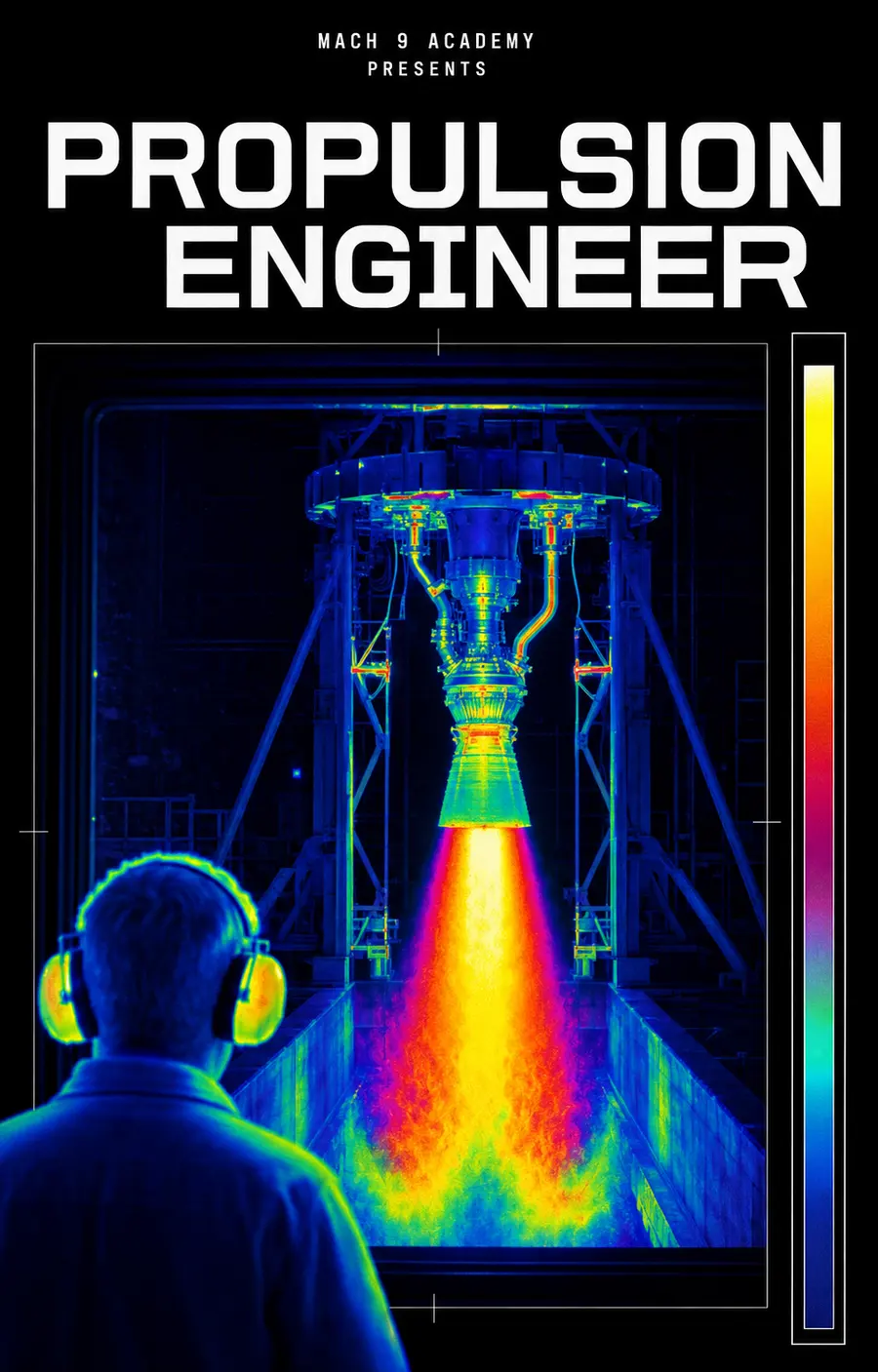
Propulsion is where thermodynamics stops being a subject and becomes a physical object that gets very hot. The work spans turbomachinery, combustion, cooling, and the instrumentation that tells you what happened during a four-second hot fire.
A typical day
- 01Model combustion and cooling performance
- 02Design test articles and instrumentation
- 03Sit console during hot fire and call abort criteria
- 04Reduce test data and correlate it against the model
How people get in
- Engineering degree
Usually with a thermofluids emphasis. University rocketry teams are a genuine hiring signal.
How it unfolds
- DegreeAerospace or mechanical, with thermodynamics taken seriously.
- Years 1-3Test support and data reduction. You learn engines by watching them fail.
- Years 4-8Component design (turbomachinery, combustion, cooling) and the test campaign to prove it.
- LaterEngine architect, or leading a test facility.
Is there a job in it
- Employed now
- 68,700
- Projected change
- +8% by 2034
- Openings a year
- 3,800
Aerospace engineers · US Bureau of Labor Statistics, Occupational Outlook Handbook, May 2024 wages and 2024–34 projections.
Counted inside "aerospace engineers", along with every other engineering discipline that works on air and space vehicles. There is no separate published line for this specialism.
The hard parts
Hot fires happen at inconvenient hours and a four-second test can undo four months of work. The margins are thin and the failure modes are energetic. Getting a design wrong is expensive in a way that software is not.
What you would need
- Thermodynamics
- Heat transfer
- Data analysis
- Test safety
- Median pay
- $134,960
- Aerospace engineers, May 2024. US Bureau of Labor Statistics.
- Typical education
- Bachelor's or Master's in aerospace or mechanical engineering
- Routes in
- Degree
- Field
- Aerospace